
Overview
How does Dr. Bhargava Mulpuri treat colorectal & small intestine conditions?
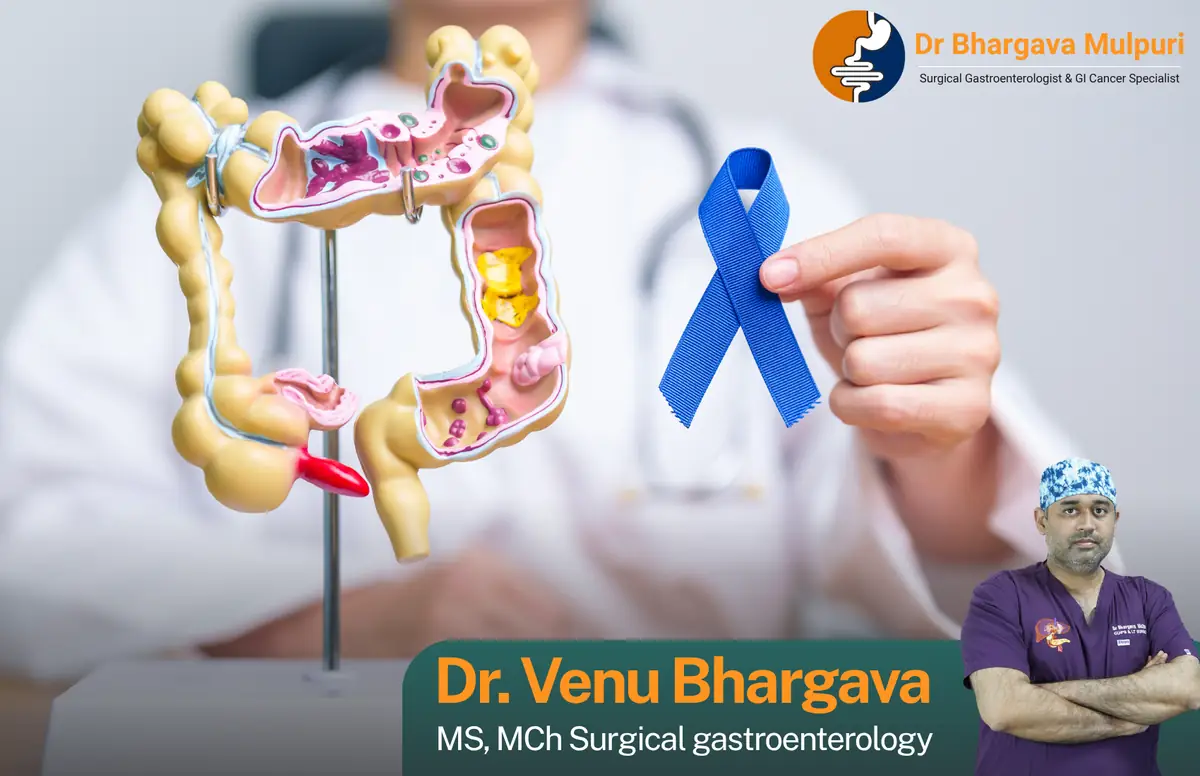
The colon, rectum, and small intestine carry out vital roles in digestion, absorption, and elimination. When disease strikes these organs, the impact can range from quiet changes in bowel habit to life-threatening emergencies such as obstruction, perforation, or uncontrolled bleeding. Families in Hyderabad and throughout Telangana often delay seeking help because symptoms feel embarrassing or are mistaken for simple gastritis or piles. Timely assessment by a surgeon trained in complex gastrointestinal disease can change outcomes dramatically, especially for colorectal cancer, inflammatory bowel disease, and acute intestinal blockages. Dr. Venu Bhargava Mulpuri, MCh Surgical Gastroenterology from PGIMER Chandigarh, provides dedicated colorectal and small bowel care at KIMS Arete Hospital, Gachibowli, Hyderabad. With more than fifteen years of surgical experience, participation in over twelve thousand procedures, and follow-up of more than fifteen thousand patients, he offers structured evaluation, honest counselling, and advanced operative options aligned with international standards adapted to local needs.
Colorectal and small intestinal surgery is not only for people already diagnosed with cancer. Many patients benefit from specialist input when chronic symptoms persist despite medical treatment, when imaging suggests a mass or stricture, or when hospitalisation for obstruction or bleeding has occurred. Adults with rectal bleeding, unexplained iron-deficiency anaemia, persistent abdominal pain, weight loss, or alternating constipation and diarrhoea should consider formal colorectal assessment. Individuals with a family history of colorectal cancer or polyposis syndromes may need surveillance and preventive strategies. Patients with known Crohn's disease or ulcerative colitis who develop worsening pain, fistulas, abscesses, or failure of medicines to control inflammation may require surgical planning alongside gastroenterology care. Elderly patients with diverticular disease complicated by infection, perforation, or recurrent episodes also belong in this pathway, as do those with suspected small bowel tumours presenting as obstruction, occult bleeding, or unexplained nutritional deficits.
Colon and rectal cancer remains a leading concern for Indian adults, yet early stages are often curable with surgery and appropriate adjunct therapy. Rectal cancers in particular demand careful staging because treatment may combine neoadjuvant therapy with precise sphincter-preserving resection. Small intestine cancers are less common but frequently diagnosed late because symptoms mimic benign conditions. Polyps, low-grade dysplasia in longstanding colitis, and certain hereditary syndromes create a group who need endoscopic or surgical risk reduction before invasive cancer develops. Inflammatory bowel disease surgery addresses complications that medicines alone cannot resolve: strictures causing blockage, penetrating disease with fistulas, toxic colitis, and cancer surveillance in burned-out segments. Intestinal obstruction, whether from adhesions, Crohn's strictures, malignancy, or intussusception in select adult scenarios, requires urgent differentiation between conditions managed with conservative care and those needing immediate operation. Diverticular complications such as Hinchey stages of perforation, fistula to bladder or vagina, and smouldering sepsis often need source control and planned resection rather than repeated antibiotic cycles alone.
Advanced resections and restorative procedures define modern colorectal practice. Low anterior resection with careful nerve preservation, abdominoperineal resection when sphincter involvement is unavoidable, and extended colectomy for pan-colonic disease are planned with bowel preparation, enhanced recovery protocols, and multidisciplinary input when oncology is involved. For ulcerative colitis and selected familial syndromes, ileal pouch-anal anastomosis after total proctocolectomy offers internal continuity without a permanent ileostomy in suitable candidates, though patient selection and long-term pouch function counselling are essential. Crohn's disease rarely follows a one-size-fits-all resection strategy; bowel-sparing techniques, strictureplasty for selected narrow segments, and resection of localized disease while avoiding unnecessary short gut are central themes. Small bowel resections, enterectomy for tumours, and bypass or staged procedures for complex fistulizing disease fall within the same specialised skill set. Each plan weighs cancer clearance, symptom relief, quality of life, and future medication options.
Evaluation begins with a detailed history that explores bowel pattern, blood or mucus in stool, nocturnal symptoms, fevers, oral ulcers, joint pains, and prior surgeries or hospitalisations. Physical examination includes abdominal palpation, perianal inspection, and digital rectal examination when appropriate, steps that remain indispensable even in an era of advanced scans. Blood tests assess anaemia, inflammation, nutrition, and organ function. Faecal occult blood or immunochemical tests and calprotectin may support decision-making but do not replace endoscopy when suspicion is meaningful. Colonoscopy with biopsies remains the cornerstone for cancer, polyps, and colitis surveillance. CT or MRI of the abdomen and pelvis clarifies extent of diverticular sepsis, fistula tracks, liver metastases, and locoregional staging for rectal cancer; MRI pelvis is especially valuable for rectal mesorectal assessment. Small bowel evaluation may require CT enterography, MR enterography, capsule endoscopy, or device-assisted deep enteroscopy depending on the clinical question. At KIMS Arete Hospital, Gachibowli, Hyderabad, these modalities are coordinated so patients avoid duplicate testing and receive a consolidated surgical opinion.
When you consult Dr. Venu Bhargava Mulpuri, the goal is a clear map of your condition: what is known, what must be confirmed, and what can wait versus what cannot. He explains imaging in plain language, discusses whether endoscopic therapy might suffice, and outlines surgical scenarios including stoma possibilities when safety demands temporary diversion. Second opinions are welcomed, particularly for pouch surgery, recurrent Crohn's resections, or borderline resectable rectal disease. For cancer pathways, tumour board discussion with medical and radiation oncology colleagues is arranged when required so that sequence of treatment, surgery first versus neoadjuvant therapy, is chosen deliberately rather than by default. Non-cancer inflammatory conditions receive equal rigour because rushed resection in Crohn's disease can accelerate recurrence; medical optimisation and nutritional rehabilitation often precede elective surgery. Emergency presentations such as complete obstruction, free perforation, or ischemic bowel are triaged for immediate intervention, with damage-control strategies when physiology is compromised.
Treatment options span minimally invasive laparoscopic and robotic-assisted approaches where anatomy and prior surgery permit, as well as open surgery when extensive adhesions, fistula complexity, or oncologic clearance requires wide exposure. Enhanced recovery after surgery pathways emphasise early mobilisation, judicious fluid management, and pain control that avoids prolonged ileus. For rectal cancer, total mesorectal excision principles guide dissection to reduce local recurrence. Sphincter preservation is pursued when oncologically sound; when not, definitive abdominoperineal resection is discussed with stoma education preoperatively. Strictureplasty can relieve obstructive Crohn's disease without shortening bowel length. Internal fistulas and abscesses often need drainage, seton placement, or staged resection. Diverticular surgery ranges from laparoscopic sigmoid resection after controlled sepsis to Hartmann's procedure with later reversal when conditions allow. Small bowel tumour resection includes lymph node clearance appropriate to histology. Pouch surgery involves hand-sewn or stapled construction with careful assessment of anal sphincter function and patient commitment to follow-up.
Choosing a surgeon for colorectal and small bowel disease is choosing someone who will stand with you through decisions that affect dignity, nutrition, and long-term health. Dr. Mulpuri's training at PGIMER Chandigarh, one of India's premier institutes for surgical gastroenterology, provided deep exposure to complex resections, trauma, and postoperative critical care. His practice in Hyderabad integrates that academic rigour with high-volume community experience reflected in more than twelve thousand procedures and longitudinal care of more than fifteen thousand patients. He prioritises oncologic safety and bowel preservation in equal measure, recognising that both matter over decades. Communication with referring physicians and gastroenterologists is routine so that medical therapy and surgery complement rather than compete. Patients appreciate transparent discussion of risks including anastomotic leak, stoma need, sexual and urinary function after rectal dissection, and recurrence patterns in Crohn's disease. Such conversations before surgery reduce fear and improve adherence to rehabilitation steps afterward.
Recovery and follow-up are as structured as the operation itself. After major colorectal resection, hospital stay length depends on whether a stoma was created, how quickly bowel function returns, and whether complications arise. Early ambulation and breathing exercises reduce pulmonary complications; supervised diet progression prevents unnecessary nausea. Stoma therapists educate patients on appliance care, skin protection, and when to seek help for dehydration or blockage. After discharge, clinic visits monitor wounds, review pathology, and plan adjuvant therapy for cancer when indicated. For IBD, maintenance medications are reconciled with surgical changes in anatomy. Pouch patients undergo regular assessment for pouchitis, stricture, or irritable pouch symptoms, with endoscopy scheduled per protocol. Nutritional support addresses protein loss, vitamin B12 after terminal ileum resection, and bone health in chronic steroid users. Long-term cancer surveillance includes periodic colonoscopy, CEA blood tests where appropriate, and imaging for high-risk stages. Teleconsultation can bridge visits for patients travelling from districts outside Hyderabad, though physical examination remains important at key milestones.
When should you seek consultation without delay? Red-flag symptoms include persistent blood in stool, black tarry stools, pencil-thin stools, abdominal distension with vomiting and absence of flatus, high fevers with severe left lower abdominal pain, unplanned weight loss, or a palpable mass. Anyone with a new diagnosis of colorectal or small bowel cancer should arrange surgical opinion promptly to avoid gaps between staging and treatment. Crohn's or colitis patients facing hospitalisation for flare, suspected perforation, or toxic megacolon need urgent specialist care. Prior abdominal surgery with escalating pain and bloating may signal adhesive obstruction requiring intervention. Post-radiation strictures, anastomotic complications from previous operations, and suspected recurrence after prior cancer surgery are best evaluated in a centre accustomed to reoperative pelvis and hostile abdomen scenarios. Even when prior doctors suggested no further options, a focused review may reveal salvage resection, stoma creation for quality of life, or participation in structured palliative pathways with symptom control.
Your colorectal and small intestine journey may begin with uncertainty, but it should not remain there. Whether you need cancer staging, IBD surgery after years of medical therapy, emergency relief of obstruction, definitive management of diverticular fistula, or evaluation of a small bowel tumour, specialised surgical assessment clarifies the next step. Dr. Venu Bhargava Mulpuri, MCh Surgical Gastroenterology (PGIMER Chandigarh), welcomes consultations at KIMS Arete Hospital, Gachibowli, Hyderabad. Bring prior reports, endoscopy images, and a list of medicines so your first visit is productive. Early, expert input often preserves bowel length, sphincter function, and life itself; delay, conversely, narrows options. Reach out to schedule an appointment and discuss how personalised colorectal and small bowel surgical care can restore health and confidence in daily living.
Patients travel from Attapur, Upperpally, Mehdipatnam, Rajendranagar, Ameerpet, Banjara Hills, and across Telangana for colorectal & small intestine care with Dr. Venu Bhargava Mulpuri at KIMS Arete Hospital, Gachibowli (PIN 500104).
Clinical focus
Which colorectal & small intestine conditions need surgery?
Specialist evaluation and surgical care for the following colorectal & small intestine conditions at KIMS Arete Hospital, Gachibowli.
01Colon cancer & rectal cancer
Comprehensive surgical management of colon and rectal cancer with advanced resections, laparoscopic techniques, and precise tumour clearance to improve survival rates.
02Inflammatory bowel disease (Crohn's & ulcerative colitis)
Specialised surgical solutions for inflammatory bowel disease (IBD), including Crohn's disease and ulcerative colitis, for patients unresponsive to medical therapy.
03Intestinal obstruction (benign / malignant)
Expert management of intestinal obstruction, whether caused by cancer, adhesions, or benign conditions, using safe and timely surgical intervention.
04Diverticular disease complications
Surgical care for complications of diverticular disease, including abscesses, perforations, and severe bleeding, ensuring long-term bowel health.
05Small bowel tumours
Advanced treatment for small bowel tumours, including laparoscopic and open resections, offering accurate diagnosis and effective cancer management.
06Pouch surgeries & advanced colorectal resections
Expert in pouch surgeries and complex colorectal resections for cancer, IBD, and functional disorders, restoring bowel continuity and quality of life.
What happens during your visit
Step-by-step care pathway in Hyderabad
From first consultation at KIMS Arete Hospital, Gachibowli to recovery follow-up - a clear pathway patients can expect.
- 1
Consultation
Meet Dr. Venu Bhargava Mulpuri at KIMS Arete Hospital, Gachibowli for history, examination, and a clear treatment plan.
- 2
Investigations
Blood tests, imaging (USG / CT / MRI / endoscopy as needed), and fitness assessment before any procedure.
- 3
Treatment discussion
Review laparoscopic vs open options, risks, expected hospital stay, and recovery timeline in plain language.
- 4
Procedure & hospital care
Surgery is performed with peri-operative monitoring and coordinated nursing care at KIMS Arete Hospital, Gachibowli.
- 5
Follow-up
Wound review, diet guidance, medicine titration, and long-term surveillance when cancer or transplant care applies.
Medically reviewed by
Dr. Venu Bhargava Mulpuri - MCh Surgical Gastroenterology
Surgical Gastroenterologist, HPB & Liver Transplant · 15+ years · KIMS Arete Hospital, Gachibowli
Authoritative references
Educational context draws on recognised public-health and medical research authorities.